Morningside flood-relief project completion
Published on 17 December 2025
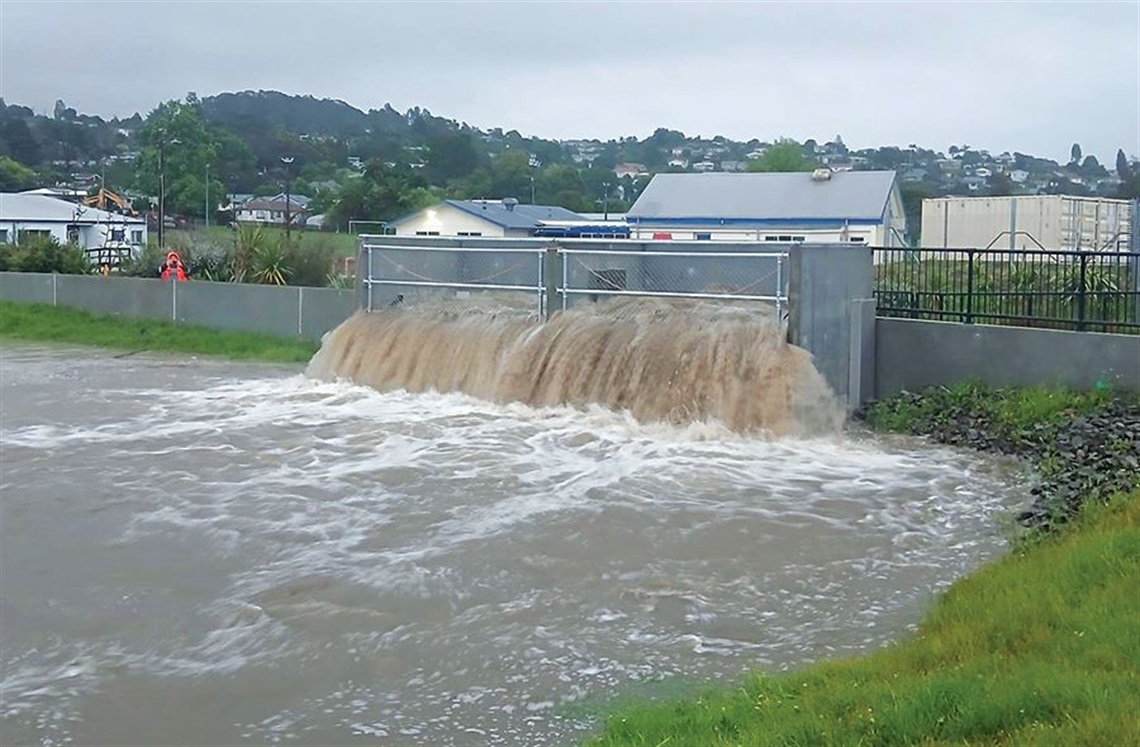
New pumps at the end of Rawhiti Street were tested at full capacity during heavy rain in November 2025, pumping 4.6 cubic meters of water per second.
Frequent flooding around Kaka Street and other low-lying areas of Morningside is set to become a distant memory as the Morningside flood-relief project nears completion.
A new pump station situated at the end of Rawhiti Street demonstrated its effectiveness as heavy rainfall and a high tide threatened to flood the area in late November 2025.
As water began to rise in the Rawhiti Stream and lap at the edge of the Whangārei Football Club’s carpark, the pumps automatically kicked in, pumping stormwater out of the area and into Limeburners Channel.
The rain event also provided a great opportunity to test both pumps at full capacity, so for a short time they moved 4.6 cubic meters of water per second – enough to fill the lane pool at the Whangārei Aquatic Centre in around three-and-a-half minutes.
Two sets of 1.2m- to 1.5m-wide pipeline – known as the ‘stormwater interceptor’ – has also been laid, collecting stormwater runoff from upper Morningside areas and preventing it flowing towards low-lying properties. The interceptor conveys the water directly into the Rawhiti Wetlands beneath the new pump station.
With one set of piping completed when the heavy November rain arrived, large volumes of water from the eastern side of Morningside were carried straight into the channel.
Project Manager for United Civil Grant Little says: “It’s been a massive privilege working on this project to protect the area’s residents and businesses from the devastating flooding they have experienced in the past.”
With the area being among the most low-lying in the District, surface water on Kaka Street will likely never be fully eliminated, but the investment is expected to be extremely effective in reducing the frequency and severity of floods.
The project also increased water storage in the Rawhiti Wetlands, added flood walls to maximise channel capacity, and delivered a new footbridge to Porowini Avenue above the pump station.
Final reinstatement of roads, footpaths and grass berms is underway and expected to be mostly completed before Christmas.
Brad Flower, Chair of the Infrastructure Committee, said the project had taken just 18 months from design, which was fairly fast given its scale.
He thanked local residents and businesses for their patience and cooperation, and acknowledged Whangārei Police who supported traffic-management personnel outside Morningside Primary School each morning to ensure kids arrived safely.
The project cost $5.5 million in total with $3 million funded through the Crown Infrastructure Fund. It is expected to protect the area from a one-in-50-year rainfall event.