State of Emergency lifted as impacted areas transition to recovery
Published on 03 February 2026
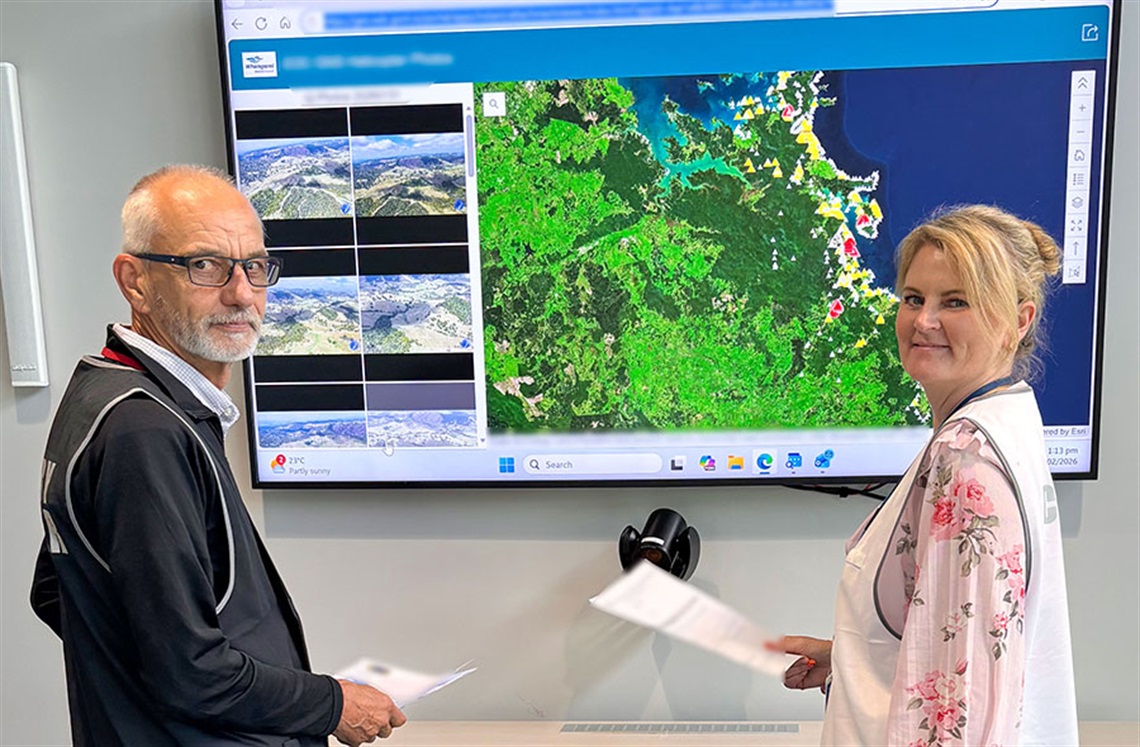
Whangarei District Council Civil Defence Local Controller Victorica Harwood and Local Recovery Manager Tony Phipps review a map of the impacted area ahead of the transition decision.
The local State of Emergency for the Hikurangi - Coastal Ward of Whangārei District will expire as of 4:00pm on Tuesday 3 February 2026 and an official transition to recovery period will then commence for the next 28 days.
The decision not to extend this State of Emergency was made this morning after consultation with regional leaders, emergency services, and welfare support agencies.
Whangārei District Mayor Ken Couper said, while challenges remain, the situation can now be managed effectively under recovery arrangements.
“There are still welfare and roading issues to work through, however with the powers available to the Local Recovery Manager, we are confident we can continue supporting our communities without the need for a State of Emergency,” Mayor Couper said.
The transition to recovery signals a shift from emergency response to longer-term recovery, restoration and community support. Some of the emergency powers transfer over into the transition to recovery phase, and coordination of welfare services, roading access and recovery activity will continue.
Mayor Couper reassured affected residents that Council and partner agencies remain committed to ongoing support.
“We have made a commitment to our affected communities, and that does not end with the lifting of the State of Emergency. We are focused on ensuring a smooth transition to recovery and that people with ongoing needs are connected with the right support and agencies.”
Roading access remains a key focus
Roading impacts will continue while the Helena Bay Hill slip is cleared over the coming weeks. The closure affects not only storm-impacted communities but also residents along the Kaiikanui Road detour route.
Managed traffic guidance is now operating on Kaiikanui Road. Following feedback about long wait times, two pilot vehicles are now coordinating traffic through hazardous single-lane slip areas to improve efficiency and safety.
Additional signage is being installed, and holiday traffic continues to be directed north via the Opua-Russell vehicle ferry.
“I want to thank everyone for their patience as we work through this detour process,” Mayor Couper said. “We will continue refining traffic management to ensure safe access while minimising disruption to local residents as much as possible.”
Mayor Couper also acknowledged the significant efforts of local marae, community groups, volunteers, emergency services and support agencies.
“The response we’ve seen across our District has been exceptional. Our marae, community leaders, volunteers and partner agencies stepped up when it mattered most. Their support and collaboration have made a real difference for those affected by this event.”
Whangarei District Council Local Recovery Manager Tony Phipps said the recovery hubs provided a strong starting point for recovery.
“Bringing key support agencies directly to affected communities has helped us identify welfare needs early and connect people with services they may need in the weeks and months ahead.”
The recovery hubs, held across impacted areas, provided whānau with access to information, welfare and recovery services, and the opportunity to connect face to face with support agencies.
This was the first time a recovery hub model of this kind has been trialled in New Zealand following a Civil Defence emergency.
Around 450 people attended the hubs over three days. Feedback from both the public and participating agencies has been overwhelmingly positive, with many valuing the ability to engage in person rather than by phone.
Due to their success, additional recovery hubs are being considered in the coming weeks.
Agencies continue to meet regularly to ensure the right support is in place as longer term recovery needs emerge.
Mr Phipps encouraged anyone who has not yet sought support to explore available options.
“People shouldn’t feel they have to soldier on alone. Talking with whānau, friends, colleagues or support agencies can make a real difference – we don’t want anyone feeling isolated.”
Financial and accommodation support available
Emergency Recovery Fund
Whangārei District Council’s Emergency Recovery Fund was open to those affected by the January 2026 severe weather in:
- Hikurangi–Coastal Ward (Whangārei District)
- Ngaiotonga, Te Rawhiti and Whangamumu (Far North District).
The fund supported individuals, families, community groups, marae and small businesses.
The Emergency Recovery Fund closed on Sunday 15 March 2026.
Civil Defence Emergency Payments (MSD)
Financial assistance may be available for essential costs such as food, clothing, bedding, accommodation and loss of income.
Work and Income (workandincome.govt.nz)
Phone: 0800 559 009
Temporary Accommodation Service (TAS)
Support is available for people displaced by natural disasters.
Register online (tas.mbie.govt.nz)
Phone: 0508 754 163
Insurance claims support
New Zealand Claims Resolution Service (nzcrs.govt.nz)
More information
Get the latest updates and a list of available support:
Latest updates
Or contact Council directly:
Phone: 0800 932 463
Our contact centre operates 24 hours a day, seven days a week.